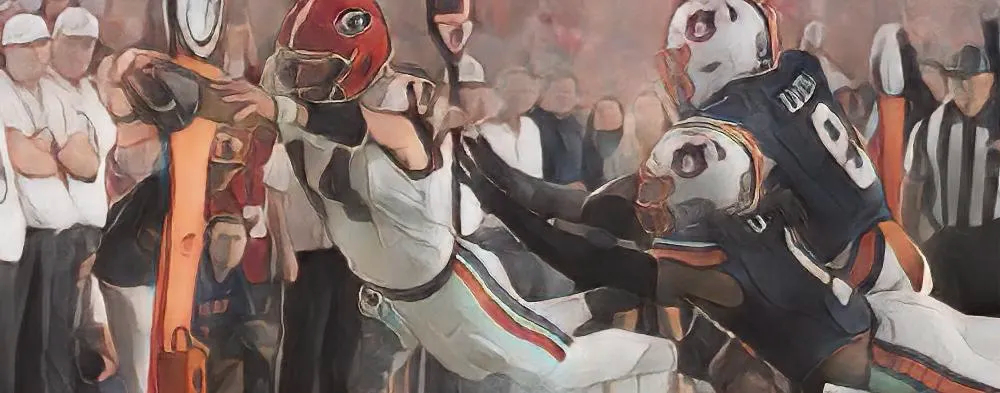
Let all the Bulldog faithful rally behind the men who now wear the red and black with two words, two simple words which express the sentiments of the entire Bulldog Nation: Auburn Sucks.
The Portal. NIL. Paying players directly. Potential collective bargaining for players. Increasing ticket and donation requirements for season ticket holders. The list goes on and on with the many changes we’ve seen in our beloved sport. Most recently, it’s the sudden expansion next year to a 24-team playoff.
Some of us have commented how these changes have changed how we feel about spending our time and energy on something that is becoming unrecognizable (or perhaps, recognizable as it morphs into NFL-Lite).
The schools and athletic programs seem to give lip service to the quaint idea that these players we enjoy watching are still Student Athletes, while acquiescing to the changes that may very well destroy what makes college football special. They argue that the regular season won’t be diminished as more teams and fanbases have something to pull for deeper into the season. Perhaps.
For our thoughtful discussion:
As supporters of a program that fortunately, for now, sits in the rarefied air during this major transition, how does all of this affect your willingness to pony up more and more of your hard-earned money, or your time spent watching games in person or on the TV, or your willingness to read and comment on the punditry here at GTPR?
SEC presidents voted Monday to adopt uniform NIL and revenue-share contracts across the league, effective immediately, sources told CBS Sports.
The SEC joins the Big Ten as the second power conference to adopt standardized athlete contracts. Schools can share up to $21.6 million in revenue directly with athletes this academic year, the second year of the 10-year window under the House v. NCAA settlement. Players received nearly $1.8 billion in direct revenue-share payments during the 2025-26 school year, according to the College Sports Commission.
The SEC’s new NIL contract includes customizable sections, sources said, but CBS Sports was not given specifics.
The Big Ten drafted a standardized memorandum of understanding for its schools before the House v. NCAA settlement took effect in July 2025. The template allowed schools to tweak and customize the deals.
Public records requests in January 2026 revealed notable differences among member institutions in the Big Ten’s standardized agreements. For example, Washington added a liquidated damages clause for a player entering the transfer portal, making him or the new school liable for the remainder of the contract’s value, according to documents obtained by Kristi Dosh of Extra Points.
Multiple Power Four programs face College Sports Commission investigations over alleged NIL cap evasion
The documents also include provisions granting termination rights in the event of a head coaching change, medical disqualification or a violation of a morals clause.
Schools can claw back a prorated share of money already paid in Big Ten contracts, according to a January 2025 Sportico report. The Big Ten also added a clause titled “No Employment,” which requires the player to acknowledge he is not an employee and waive any claim that he is.
When athletes sign an NIL agreement with a school, they grant the school rights to their name, image and likeness for use by the school, which are typically also sublicensed to the conference, the NCAA, TV partners and sponsors.
The SEC circulated a suggested NIL contract template to its schools in 2025, according to ESPN, which obtained a copy at the time. That version barred athletes and their representatives from trying to “initiate, solicit, entertain, negotiate, accept or discuss” offers from other schools while under contract and required them to notify their school of any outside interest — otherwise known as tampering.
Now granted, it says – very clearly – that the B1G has already done this, and they set the precedent for this. However, if you’re trying to tell me that every B1G member institution is abiding by it – which the article clearly states they aren’t – then I might need you to sit down for this one.
What’s worrisome is that Sankey strikes me as the kind of guy who will actually enforce it and regulate it, while the B1G continues to allow its teams to run amok and win national championships while SEC programs are told to behave and wave bye-bye to players choosing to sign contracts with other conferences.
While we’ve seen the short-term effects play out on the field – lack of roster stacking, depth (I guess that’s why Alabama only had one receiver Saturday, right?), and maintaining consistency of the roster for multiple years – Kirby seems to have found a way to stabilize this in recent years, but this could add yet another wrinkle to the system. To make it worse, it adds another level of stress for coaching staffs and schools to figure out how to make it work.
What’s more concerning, in what’s becoming the NASCAR era of college football NIL deals with logos all over the place and college players inking deals with companies (look at any of a number of cringe-worthy ads featuring Arch Manning), will only further encourage more third-party deals and backroom shenanigans than ever before.
What’s worse, it might make some folks, like Kirby, decide to hang it up in frustration. Just when it seems like he’s got it down, they go and make another change.
Or, maybe, this is where teams decide to branch off from conferences and form their own league.
It could happen. Hell, Indiana won a national championship in football.
In what should come as a surprise to literally no one at all, the College Sports Commission has discovered that several programs, including an unnamed 10 Power Four programs, have violated the NIL spending cap by going around the backdoor and working with third party vendors to boost their revenue sharing agreements.
Any money a student-athlete receives from a third-party must clear the CSC approval process, where it’s examined to see if the deal meets a fair-market range of compensation. In July, the CSC amended its rules to exempt all deals between $600 and $15,000 from the range of compensation review as long as that athlete has made $50,000 or less in “associated” deals. If the athlete is above that $50,000 number, the review is back in effect.
With seven college football rosters ballooning into $40 and, in a few cases, $50 million range, according to previous CBS Sports reporting, schools are spending well beyond the rev share number, which is meant to serve for all sports. Given $40 million football rosters and $10-million-plus basketball rosters just to be competitive, schools are attempting to generate tens of millions in third-party money for their athletes just to remain competitive. There is no cap on how much a team can spend as long as the deals are submitted and approved as being in accordance with the fair market range of compensation through the CSC’s process.
In September, the CSC reported that through its platform NIL GO it had cleared $227.25 million in deals between July 1 and Aug. 31. However, it failed to clear $67.08 million during that period in deals that did not meet fair-market-value standards or the terms of the House Settlement agreement.
While the article doesn’t name anyone in particular, one program unsurprisingly rose to the top of the media outlets as being a guilty party:
As word would have it, Marcel Reed’s 2.8 million dollar NIL deal was brokered and listed as part of the athletic department’s “agricultural equipment” budget.
It’s kind of like we’ve welcomed the mafia into college football, not only from the betting sense with gambling site ads all over the games and even on ESPN, but to allowing people like Al Capone and his famed accountant to cook the books to make programs richer.
And the better question, once it’s discovered who these teams are, is what are the results? If a team gets busted for violating the spending cap and doesn’t have the results to show for it, what was it all for?
One guess I have, and I’m no expert here, is that Kirby Smart and the UGAAA aren’t going to be named as a party of guilt in this matter. And I appreciate that, for sure.
— College Transfer Portal (@CollegeFBPortal) October 4, 2026
Meanwhile, in business decisions, I’m guessing that JuJu Lewis is regretting not sitting on the bench in Athens and learning from Gunner Stockton and Mike Bobo the past two seasons.
NEW: Coach Prime says he’d “love" for QB Julian Lewis to "come here and tell you what happened.”
Prime says that JuJu wasn’t benched: "It didn't happen like that."
— College Transfer Portal (@CollegeFBPortal) October 4, 2026
Social media had some posts on it with this image, and what sounded like an obituary to JuJu’s Colorado career.
As word would have it, JuJu has chosen not to play anymore for Coach Prime or the Buffaloes, but will still collect his $1.8 million check to watch the Buffaloes continue to implode.
I’m not sure if he’d transfer to Georgia or not, but if he does, it ain’t gonna be for close to two million dollars, I can tell you that. He might comes as a Jaden Rashada type to take a year off and repair his value, but he won’t be starting in Athens and I don’t think Kirby would waste the money.
After all, you’d expect someone to come in fully developed after being in college for two years, but Prime isn’t exactly a developer for anyone who doesn’t have Sanders in their name.
NEW: Georgia head coach Kirby Smart reveals a unique NIL incentive for WR London Humphreys:
"He’s got a deal in his NIL incentive, the more special teams he plays, the more money he gets. So he wants to be on special teams. He wants to play every snap on special teams. I keep… pic.twitter.com/UpFH8nyelv
Interesting. Why, though? Well, like all things college football today…it’s money.
Norvell remains unlikely to be fired if the Seminoles lose that game, but if the scoreline is ugly enough, it could lead to an immediate change. If that were to happen, the nearly $50 million he would be owed in a buyout would strap FSU financially in its coaching search, and that could give Fisher the upper hand.
Fisher was fired from Texas A&M in 2023 and became the recipient of the largest buyout in college football history, $77.6 million. So Fisher could take a cut-rate salary to lessen the stress on the program and offer an immediate arrival.
Hey, he’s already rich…so it won’t really cost nothing, will it?
Never mind Fisher couldn’t accomplish anything with what was assuredly some of the highest paid rosters out there with a stacked blue chip class of players (who ultimately never panned out)…but he’s affordable!
There’s a reason Florida State hasn’t been relevant since the 63-3 drubbing by Georgia, and it’s not all because Georgia killed their will.
Good luck with that, Seminoles. When you have Publix tastes on an Aldi budget, sometimes you have to look for a steal.
Color me surprised that Auburn and South Carolina are spending more than Georgia and have nothing at all to show for it, except a new coach and one who could be on his way out.
Ditto for Nebraska, Michigan, and USC. What’s lost here is the individual payouts, where I’d imagine Kirby takes a more balanced approach to spread the wealth while a team like Michigan invested heavily in a QB that has people wondering why they did that.
And then there’s Oregon, Texas and tOSU. Top of the list yet no titles for two of them and Ohio State seemingly lucked into theirs and still can’t buy a decent kicker.
Indiana is lower than eleven teams that has a combined single national title, and one (LSU) that hasn’t even made the expanded CFP. Tennessee has made it once, getting hammered by the Suckeyes 42-9 and didn’t make it in last year at all.
And while Dabo preaches that he doesn’t like transfers, he is investing a lot of money into something…but what it is is beyond me. From another vantage point, consider this:
FSU fans are certainly tasting blood in the water, and are praying that they have front-row-center tickets for the kicking to the curb of the FSU Portal Master. And they’re already dreaming of a current Bulldawg heading up their program in the post-Norvell era.
If FSU cleans house, I’m thinking money first. Don’t chase 10 million dollar coaches, spend on the roster. My hires, for AD, Jeramiah Dickey from Boise State. Head Coach, Glenn Schumann. OC, Kade Bell. Strong Florida roots, he’s young, quarterback guy. And DC, Travaris Robinson, Schumann’s co-DC right now. – @JovaniDiaz35 on X (graphic credit to Jovani and AI)
Don’t chase $10 million coaches? Have they never heard of Jimmy Sexton? Hell, whoever they bring in will likely command a high dollar contract, and if it’s Schu, well, good on him. He’s put his time in and you’d be hard to argue against hiring from the Smart coaching tree (wait, what about Oregon?).
Give them credit for their optimism, that’s all they’ve got right now. In truth, I’m sure Schumann would like to bring Robinson with him, although I think Kirby would offer a nice chunk of change to retain as much Georgia staff as necessary and let Schumann pick from other places.(note: Fran Brown hasn’t exactly been doing well at Syracuse, so he could always come back to Athens or head to Tally, if this is the manifested destination).
Leta face it, it’s way cheaper to buy out an AD’s contract than, say, this guy’s…
A lingering question sources have told On3 in recent days is whether Florida State moves on from Norvell and who would make the next hire. Alford’s firing signals he will not make the final decision on Norvell or who will handle a possible coaching search.
Senior associate AD Bruce Warwick will serve as Florida State interim athletic director, sources tell On3.
“Changes like this are never easy, but sometimes necessary,” Florida State Board of Trustees Chairman Peter Collins said in a statement. “We have made significant investments and structural changes in our athletics program and Seminole Boosters over the past few years, but more are needed. This step begins the next phase of restructuring that the University must commit to in order to compete in this era of college sports. ”
Alford brought Norvell back for the 2026 season despite a 2-7 finish in 2025 after starting the year 3-0. Florida State is 8-18 since its ACC championship game win in 2023.
With FSU fans crowdsourcing Norvell’s buyout, safe to say that losing the AD is just the first domino to fall.
Sometimes, Kirby just has a way of breaking you. Let’s hope he’s done it to another guy, too…
Kalen DeBoer offered several interesting explanations following the Crimson Tide’s win over Kentucky.
His comments about the equipment failure in the second half especially caught my attention.