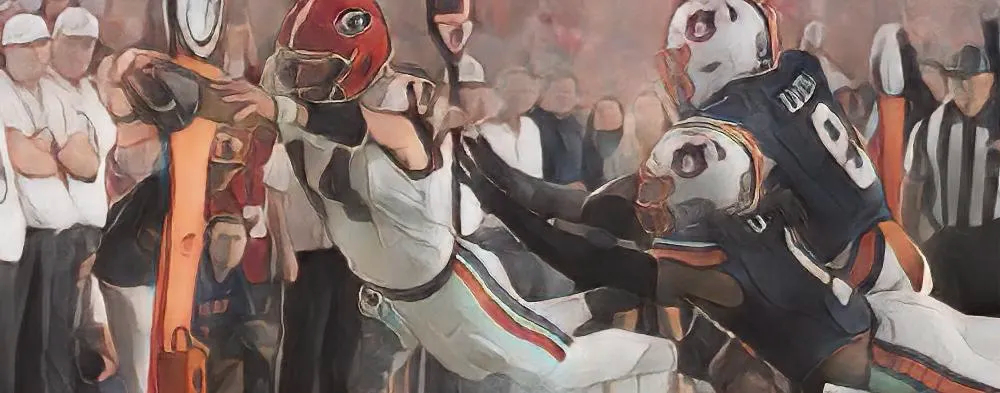
Let all the Bulldog faithful rally behind the men who now wear the red and black with two words, two simple words which express the sentiments of the entire Bulldog Nation: Auburn Sucks.
Texas Tech lost the battle in the courtroom of public opinion when they thought sports fans outside Lubbock, Texas would empathize with a player fighting a mental health demon fighting against the NCAA. Instead, they found a public who felt bad for the QB and also wanted the same QB to feel the consequences for his actions.
At the end of the day, pressure from the Big 12 office and the conference’s athletic directors and head coaches likely forced the Red Raiders’ hand to negotiate an exit based on mutually agreeable terms and an air-tight non-disclosure agreement.
When public opinion is on the NCAA’s side, you know you’re going to lose in the end.
If you are going to another site for your Dawgs’ content today, make it the guys at Dawg Sports. This defense of the Georgia-Clemson home and home is a magnum opus (Someone needs to send this to Josh Brooks – athdir@uga.edu). The good Senator would be smiling over this if he were with us today.
I’ll say it now. I refuse to purchase tickets to either of these games if they move to a neutral site (yes, I attended both games in 2021 and 2024). I may even decide to hell with it and not even watch the games on television on principle. I get that schools have to look for every revenue stream they can at this point, but the powers that be look at us as nothing but wallets at this point in the name of looking out for what’s best for UGA athletics as opposed to what’s popular to fans.
I carried the ticket stub from 1984 in my wallet for years after that. I wish I had kept it pristine and gotten a signed picture of Kevin Butler kicking the most famous field goal in Georgia history.
If we don’t reject this kind of thinking while still getting OOC games with the likes of Tenn State and WKU in our season ticket packages, we’ll get more of this.
It’s time for these people to feel the economic impact of the decisions they make rather than to tell us they know what’s best for us.
The one benefit of the chaos of the current state of the college football NIL market is this:
"I talked to an NFL scout last week…"
"Last year rounds 6 and 7 wiped out from NFL, this year rounds four through seven wiped out from NIL."@AndrewBrandt discusses the impact NIL has on the NFL Draft on this week's Business of Sports:9 pic.twitter.com/ssnS9suUys
The union closed shop with a rookie salary cap and scale doesn’t allow players to be eligible for their league until 3 years out of high school. The owners and player personnel people of the teams have taken advantage of the college football system as a free minor league for decades are crying because the back end of the draft has dropped off due to free market NIL.
A player with eligibility remaining with a late 3rd round or later grade can improve his draft stock and get paid for it instead of rolling the dice in the draft and betting he can make a team. He likely is able to make as much or more with less risk by returning to college for that 4th or 5th year.
NFL insiders cannot let this stand.
The law of unintended consequences is still the 1972 Miami Dolphins.
Pass the Kleenex.
Maybe this will bring the NFL to the table to discuss how they can work more effectively with the power brokers of college football.
We have a lot of problems to solve as a country, but the President has decided to wade into the NIL mess created by the NCAA, its membership, the jackass-in-chief Mark Emmert, and the antitrust plaintiff’s bar with an executive order called “Saving College Sports.” I’m not going to get into the constitutional law of this order or the politics of this, and this is not the space to debate either of those topics … Derek can take that up on Wednesday if he so desires.
After reading the order, here are a couple of items I thought were interesting:
Overall, did the NCAA’s attorneys write Section 1 of the order?
The rationale for the order is all wrapped up in the NCAA’s past arguments for maintaining the façade of amateurism and current arguments for some kind of antitrust exemption. Olympic sports, academics, state laws, system where schools can buy the best players, and women’s sports are all arguments of the NCAA for intervention.
“It is common sense that college sports are not, and should not be, professional sports …”
We all need to face that college football and men’s basketball especially in the Power 4 conferences are now professional sports. The college sports industry made all of the decisions since NCAA v. Board of Regents of the University of Oklahoma and the University of Georgia in the interest of generating more money over time.
The bag men plus the facilities arms race show that college athletes have a market value. Church steeples, Trans Ams, McDonald’s bags, and $100 post-game handshakes were the underground labor market while $10,000 massage chairs, miniature golf courses and other perks in athletic buildings showed how player compensation was hung up on the balance sheets of these associations. Eventually, that market value led to the O’Bannon decision on the EA Sports NCAA game franchise where the NCAA hid behind the fig leaf of jersey numbers while the demographics just happened to match the individual players represented leading to the total cost of attendance (TCOAS) scholarship. Of course, additional litigation has essentially blown up the guardrails of the TCOAS into pay-for-play thinly veiled as NIL.
The bottom line is that as the money in these 2 sports exploded, those participating were being left behind.
“… [I]t is the policy of the executive branch that third-party, pay-for-play payments to collegiate athletes are improper … This policy does not apply to compensation provided to an athlete for the fair market value that the athlete provides to a third party.”
The executive branch appears to be lining up behind the House settlement on this topic. Payments made by NIL collectives? Bad. Payments made similar to the Olympic model? Good. I admit I’m on the side of the Olympic model, but that doesn’t mean I agree with this mechanism.
I’m sure Jeffrey Kessler and his firm are already lining up to go after the order for injunctive relief. I tend to give people the benefit of the doubt on their motivation … therefore, I lean that Kessler wants the best for the members of his class. I also am cynical about actions like this based on my day job. If there wasn’t a pot of money at the end of the rainbow for his firm, his firm probably wouldn’t be interested.
Is Section 4 an attempt at an antitrust exemption by fiat?
What does “unreasonably challenged” mean? I don’t think any of the NIL litigation to this point has been unreasonable. I also don’t think anyone wants the “rights and interests of student-athletes” harmed and the “long-term availability of collegiate athletic scholarships and opportunties” reduced.
I’m not sure the Attorney General and the Chair of the FTC can do a damn thing if NIL makes a school decide to shed sports.
“Protecting Development of the United States Olympic Team”
What sports at this point purely depend on amateurs generally and college athletes specifically for participation in the Olympics?
Tackle football isn’t an Olympic sport yet. Basketball? That ship sailed a long time ago with the 1992 Dream Team on the men’s side and soon thereafter with women. Swimming? Katie Ledecky famously left the Stanford swim team while remaining in school to pursue endorsements while also swimming professionally, and Michael Phelps never put on the maize and blue while attending Michigan to train with his long-time coach. Gymnastics? Many of the women are past their prime at college age, and the GOAT never wore a college leotard. Hockey? The Miracle on Ice was a long time ago, and the Olympics are now the NHL all stars playing for country. Track and field? Most of the US athletes are professionals now across the board even though they were collegiate athletes at one time.
Summary
Is this order like Texas football … all hat, no cattle?
It would seem so because there is no real policy, and any policy is likely to go down in flames under judicial oversight.
Is this order telling Congress what framework the President is willing to sign in a bill like the SCORE Act?
In my opinion, winner, winner, chicken dinner. He is telling the 535 members of Congress he is willing to sign a bill that reforms some of the problems of college sports while maintaining that student-athletes are not employees with collective bargaining rights.
What do you think? Let us know in the comments. Keep it civil and out of the political realm. If you want to do that, take it to the Playpen.
The greed of college administrators started this ball rolling down the hill. NIL and the collectives added fuel to accelerate it. The transfer portal and the NCAA’s decision to cave on the revised transfer rules have turned it into a high-speed snowball.
I hate this for college sports below the P4 level.
Marshall, App State, and Georgia Southern were three proud brands of Division 1-AA football back in the day. It was stupid for them to make the jump to FBS.
I would love to ask Erk if he believed the Eagles jumping to the Sun Belt from the SoCon was worth the money.
Diego Pavia has sued the NCAA under antitrust law (similar to all of the NIL lawsuits) to get additional college eligibility to make up for his 2 JUCO years. This has nothing to do with playing the sport or academic opportunity … it’s all about NIL.
Between the Mars lawsuit that removed all NCAA governance of transferring and this lawsuit that pretty much challenges the NCAA’s authority around eligibility, the stage could be set for what could be the ultimate lawsuit allowing anyone to play college football for an unlimited amount of time regardless of academic standing.
We have plenty of attorneys in our merry community of refugees. Please tell me if I’m reading this right or wrong.
After watching this Saturday Down South tweet interviewing Jalen Milroe , my first thought was, “ruh roh, the Bammers aren’t going to like this”. Most of them won’t say it right now, because at the end of the day, they only care about one thing: nattys. If Kalen and Jalen can jump up and down and pat each other on the back after each “nice pass”, win football games and attain the one thing that drives the Gump economy, then all’s well.
Business trips, staying in the moment, and winning the next play has served them well for the greatest run of CFB success we’ve seen so far.
I’ll be very interested to see how things shake out September 28th when The Process East meets slap-happy look-at-me-and-what-I-just-did Crimson Tide football.