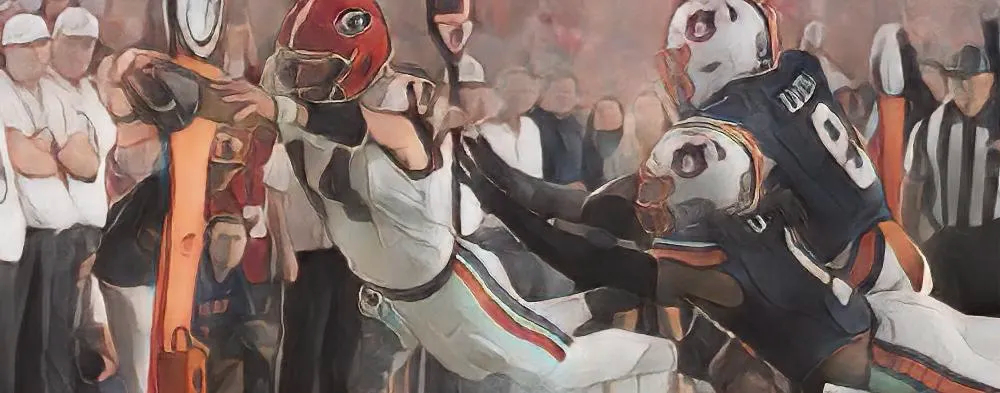
Let all the Bulldog faithful rally behind the men who now wear the red and black with two words, two simple words which express the sentiments of the entire Bulldog Nation: Auburn Sucks.
After England’s win in Atlanta yesterday, they advance to the Group of 16 and face Mexico…in Mexico. If you wonder if that’s a home field advantage, check this stat out:
Lots of England fans clearly have no idea the absolutely massive advantage that playing at Aztwca gives the Mexican side. Put aside for a second the sheer size of 100,000+ fans and intimidating atmosphere (thats only the minor advantage).
— The Heretical Liberal 🇨🇦 (@Rob_ThaBuilder) July 1, 2026
Yeah I’d say it is. Aside from the climate, the legation alone will make them gasp for air and have to snort oxygen. If you watched Mexico go to work on Monday, you’re aware that the elevation has zero effect on the home team. Good luck, Three Lions. Or bueno suerte, as they say.
Anyway, that got me to thinking…have you ever been to a game where there was a clear home field advantage for some reason? In my mind, I can think of a few, maybe Bryant Denny at night or LSU at night, or maybe this abomination:
Some are already calling South Carolina our trap game for 2026, mainly because whether it’s August at noon or December at night, it’s always a crisp 9000 degrees there with no discernible breeze.
So what say you? Can you think of a place where just playing at the venue makes it a tougher out?
Lots of high praise for the Benz during the World Cup.
“This is loads better than Wembley” was a conversation I just heard coming out of the @MARTAtransit station as some England fans saw Atlanta Stadium aka the Benz for the first time 🏴 pic.twitter.com/4k9T33EwLJ
— ⚽️Scarves and Spikes | SUBSCRIBE ON YOUTUBE! (@ScarvesNSpikes) July 1, 2026
By Atlanta Stadium, I’m assuming they mean the home of Bulldogs. If they want to see a more outdoor and smaller version, they just need to drive up the street to Mark Richt field.
— The Bulldawg Report (@ReportBulldawg) July 1, 2026
No doubt the most solid unit on the team is the defensive side of the ball, and seeing some guys coming back who’ve developed well in their time in Athens leaves on wondering what can be with this group.
There’s an embarrassment of talent on both sides of the ball, and both of the offensive and defensive sides of the ball are solid, although questionable in depth. There’s hardly a place out there where I can say we have an area of concern, although out biggest opponent (outside of the ACCPD) will be the one that’s plagued us for years: injuries.
Stay healthy, and there’s a high ceiling. Start losing guys at key positions, and the impact of NIL on roster management and stacking five stars may become apparent…but based on the graphic above, Kirby may have been quietly working the Kirby formula throughout the tumultuous NIL/Portal shifts that we’ve seen throughout the years.
What’s your ceiling and floor for the Dawgs this year? Who do you see being our trap game opponent, and why?
In case you’re not watching or not aware, there’s this whole World Cup thing going on. If you’ve watched before, then you’re definitely aware of VAR.
What does VAR stand for in soccer?
VAR stands for Video Assistant Referee. It is both the name of the system and the match official who helps the referee review major decisions using video replay.
The VAR is not on the field. The video assistant referee watches the match from a video operation room, along with other video match officials and replay operators. They have access to broadcast camera angles, replay speeds and communication with the referee crew.
The goal is not to re-referee every small call. VAR is there to help with major, match-changing decisions.
How does VAR work?
VAR checks major incidents in the background while the match is going on. The referee does not need to ask for every check. The VAR is already watching.
If the VAR sees a possible clear and obvious error or a serious missed incident, they can recommend that the referee review it. The referee can then either accept information from the VAR or go to the monitor on the sideline for an on-field review.
The referee makes the final decision. VAR can recommend a review, but VAR does not overrule the referee by itself.
That is why you will often see the referee make the TV-screen signal with their hands before going to the monitor or announcing a decision.
I’m not sure if the technology behind it, but in an instant it can assess if a player is offsides in soccer…as shown above, it works down to the inches of a toe.
The image above is from the 0-0 result of Portugal versus Columbia, and it was the difference between a Columbia win and a draw.
From what I’m able to research, FIFA, the organization behind the World Cup, generates roughly 6 billion a year in revenue, compared to the NFL’s 18. The B1G and SEC alone combined for 2.5 in 2025.
If such technology exists in a game that’s as wide open as soccer, why not for American football? A literal game of inches (note: the ABS system is in MLB, which generates 12 billion a year) where first downs and offsides calls are integral to the game doesn’t have something like this? Why? Think of how involved changes the game in the sport if not left up to individual referees?
Heavy here on the rumor part of this, but I also would not be surprised if it’s true. Last we saw of Simpson, he was sacking himself and crying about injuries as to why his drop-off in performance lead to some poor late season results. Funny, we had a QB known for using his legs and I don’t recall a time where Stetson Bennett did something like this:
Hell, Stetson Bennett is literally a walking pinball and gets several CTE-inducing hits per game, and I don’t recall a moment where anyone could’ve called him Charmin soft. Maybe some folks are just built different.
Anyway, here’s the rumor:
🚨🚨 #Rams No. 13 pick QB Ty Simpson has been unable to separate from Stetson Bennett in the Rams’ QB2 battle throughout OTAs and minicamp.
It would be nice to see another quarterback not named Stafford to get some playing time in the league. If knowing that a team that could likely be in the Super Bowl conversation is lead by two Dawgs, I’m all for it.
This happened somewhat quietly, but I know some of you will be happy to know that the era of “Bulldog Bold” fonts used with athletics has come to an end. Meet the new font for 2026:
This will be replacing the former typography, which if you don’t know what I’m referencing, it was this font:
Not much else seems to have changed, though you may be curious if the “new dawg” is still in the branding manual…and it is still there.
Progress is progress. I’d be interested to know what brought about the change.
The NCAA is one step closer to the 5-year timeclock on player eligibility.
Under the new rule, athletes in all sports will be given five years of eligibility over five seasons once their college eligibility clock begins. The clock starts upon initial full-time enrollment in college or at the beginning of the academic year following their 19th birthday, whichever occurs first.
The move is meant to eliminate the need for redshirts and waivers, which have drawn scrutiny in recent years as athletes have sued the NCAA challenging eligibility rules.
Athletes who just completed their fourth season of eligibility without a redshirt would not be granted an additional year. Schools will have flexibility in determining whether to use previous eligibility rules or the new age-based model for athletes with eligibility remaining after the 2025-26 academic year.
Prospects who graduated in spring 2026 will use the age-based model.
“With these changes, the Cabinet has taken decisive action for the benefit of student-athletes and the system of NCAA Division I athletics,” Illinois athletic director and Cabinet chair Josh Whitman said. “For many student-athletes who enroll in college immediately after high school, these changes will result in the opportunity to potentially compete for an additional season in their chosen sport. For campus officials and coaches, this change provides rules that are simpler to administer and easier to predict for roster management decisions.”
What’s not readily clear is whether that time clock starts with JUCO enrollment, but it does end the idea of redshirting and allows for five years of participation. Which makes me wonder how it would’ve affected this guy:
His first year of enrollment was 2017, which meant his eligibility would’ve ended with the 2021 National Championship and Carson Beck would’ve been piloting the 2022 team…would the results have been the same? Would Carson have survived the New Year’s Eve shooting match against Ohio State?
With NIL reigning supreme, it’s become more apparent that college athletes have less motivation to declare for the NFL draft early, which should be great for development-oriented coaches like Kirby Smart.
Now for the real question…let’s see how enforceable this actually will be. As I’m sure you are not surprised, attorneys are already chomping at the bit.
Attorneys have filed the first of these cases of players seeking an additional year of eligibility after the passage of the NCAA's new age-based eligibility standard.