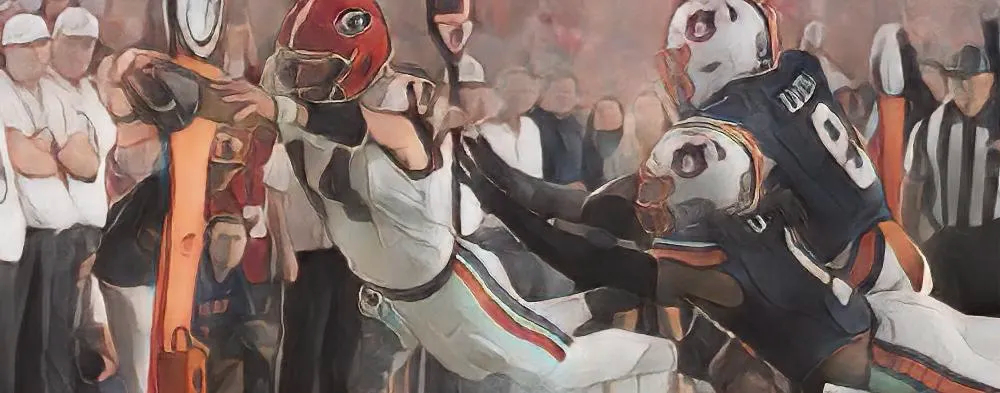
Cry me a river – NFL draft edition

The one benefit of the chaos of the current state of the college football NIL market is this:

The union closed shop with a rookie salary cap and scale doesn’t allow players to be eligible for their league until 3 years out of high school. The owners and player personnel people of the teams have taken advantage of the college football system as a free minor league for decades are crying because the back end of the draft has dropped off due to free market NIL.

A player with eligibility remaining with a late 3rd round or later grade can improve his draft stock and get paid for it instead of rolling the dice in the draft and betting he can make a team. He likely is able to make as much or more with less risk by returning to college for that 4th or 5th year.

NFL insiders cannot let this stand.

The law of unintended consequences is still the 1972 Miami Dolphins.

Pass the Kleenex.

Maybe this will bring the NFL to the table to discuss how they can work more effectively with the power brokers of college football.

Refugees, assemble and discuss.

Loopholes and A**holes: Working Around the Clearinghouse

Well, this isn’t necessarily unexpected.

Earlier this week, Yahoo! Sports reported that 18 Nebraska football players were challenging more than $1 million in third-party NIL deals rejected by the College Sports Commission (CSC), the new enforcement arm of college sports. The 18 athletes are the first group to go through the arbitration process.

The Cornhuskers are not afraid to challenge the CSC, becoming the first university to publicly enter arbitration. But sources across college sports tell On3 that Nebraska will not be the last. At least half a dozen schools across the Big Ten and SEC received notable deal denials last week, which could ultimately land in arbitration, sources tell On3.

The CSC rejected Nebraska’s deals because they violated a policy dubbed “warehousing,” when a multimedia rights partner purchases athletes’ NIL rights. Sources have told On3 that the CSC is pinning too many deals on the “associated entity” term, which is used to describe deals facilitated by NIL collectives or schools’ boosters.

In a new data release by the CSC this week, associated contracts tied to schools’ sponsors and booster-operated companies made up 63% of all NIL agreements in the last two months. In total, the CSC said 711 deals worth $29.3 million have been reviewed and not cleared.

“Frustrations are starting to boil over,” one SEC NIL collective told On3. “The CSC is taking some extreme liberties in their judgment on deals.”

And, of course, when folks get frustrated, the lawyers get involved and, eventually, the path is paved to let them do whatever the hell they want to do.

What the fuck?

And to think, Gurley and Green had to sit out games for what amounted to less than 1% of what they’re arguing about now.

Class of 2044 Recruit: I Blame the Parents

Prayers up for the mother.

Searels and Smart need to land a chopper at the hospital and bring some 6-month old sized Georgia gear to the maternity ward. They better hurry, the offers are coming in fast.

Now that’s just parody and snark, but it has a tinge of reality. After all, art imitates life. Case in point:

It’s already happening with 8U players.

Yesterday I asked a question regarding “who the hell has the money” to entertain spending millions to make a team relevant again, but I forgot that, on the other end, there is an abundance of folks out there looking to sell their kids to the highest bidder thanks to their athletic talents. After spending to showcase them at camps, it’s now another cash cow for the youth league alpha parents who are going to cash in quick.

I can’t necessarily fault a parent, to be honest. Still, the chance your thousands or hundreds of thousands of dollars invested in youth sports, travel leagues, trips, etc., actually turning into a scholarship are low, and I’d image getting a huge NIL payout is lower. But it’s certainly enticing, ain’t it?

It’s a sellers market in college sports. Buyer beware.

Growth Whore Moans

You already knew it was coming, but Arkansas is the next in the SEC to establish a partnership that will go across all sports and now adorn their uniforms.

To remain competitive, Arkansas has aggressively pursued new revenue streams, including stadium and arena concerts, stadium naming rights and jersey patch sponsorships. The Tyson partnership represents one of the largest steps in that strategy.

Learfield Sports, which represents Arkansas, is also nearing an agreement on a naming-rights deal for Razorback Stadium.

“We’re really, really close to being to the finish line on that,” Yurachek said. “We’ll have some things that people will see in the very near future about that.”

While they are trying to compete with like of Texas, which has roughly double the revenue of Arkansas, the article goes on to state that the amount of financial infusing won’t bring Arkansas close to the Longhorn$ revenue. But it also says every little bit helps, and the Tyson partnership is adamant that the revenue will not be just used for the “big three” sports, but should be spread across all 19 sports programs.

This isn’t the first program, as LSU had already struck a deal in February with Woodside Energy for more corporate sponsorship, probably to pay for Lane Kiffin’s contract alone or to invest in Bitcoin to possibly pay his buyout to come in the next 15 months. While Nike or Adidas or Under Armour have long had “free” advertising on jerseys for years, I’d have to say that free ain’t free when you consider how much an authentic jersey with the Swoosh or the pyramid (whatever the hell Adidas is) comes at a steep price to the consumer and is likely backwashing into their revenue streams.

As college sports sell their souls to corporate sponsors, the highly paid athletes and programs are becoming those folks in Vegas who slap the calling cards for ladies of the night. Handing them out on the strip to men, women, and children alike, no care for the tradition or morals, just broaden the viewing audience and hope the hooks sink in, for money. It’s cheapening the sport, but if we’re at this point, why can’t we agree to do something for the overall improvement of the fan. Similar to European soccer, if the ad is on the field and in camera view every fifteen seconds, eliminate the TV timeouts and let the ads play out as the game is watched. We get a shorter game, more continuous action, and the benefit of not watching another medical ad about a cure for an inflamed cochlea with side effects including erectile dysfunction, psychosis, nausea, paralysis, or death. What a dream come true.

Another interesting idea:

I can assure you that the ad space will be seen on fan jerseys and across the state when people buy a jersey with an authentic Tyson Foods patch on them. I can watch Premier League and not think twice about the ads, even though they’re running around on jerseys and flashing on the sideline lights for 45 consecutive minutes. But the action doesn’t stop, there’s no need for an infusion of the latest pop noise in the stadium, and the game plays as needed.

Additional question: what’s missing from the details is why only 90% will be going into NIL…where will the other 10% go? My best guess:

Billable hours.

Tom Mars and Jimmy Sexton run the college football world.