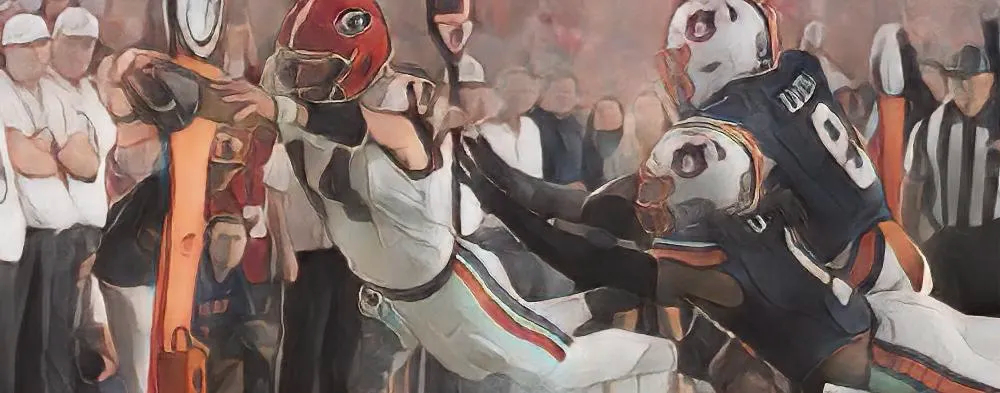
Let all the Bulldog faithful rally behind the men who now wear the red and black with two words, two simple words which express the sentiments of the entire Bulldog Nation: Auburn Sucks.
Add another name to the list of receiving talent Georgia’s added (back) to the 2025 roster.
Not much to add here. What this means about his legal issues or anything else isn’t public right now, but Smart affirmed that Young is back with the team.
Talent won’t be an issue. Catching, well, that remains to be seen.
Let’s hope we have someone to throw to them, and a line that protects that person, as well.
I’ll give him credit, at least Justus Terry is being honest. Not that anyone was wondering how an eleventh hour recruiting pitch wowed one of the top DLs in the 2025 class to Austin Texas.
I thought he wanted to be a barber in California? I digress.
Kirby has gotten a bit a reputation as a great recruiter…but he’s also getting a reputation as a frugal NIL shopper.
I have no doubt that Kirby is maximizing NIL funds, but the idea that Smart is getting guys to come to Georgia in the cheap just because he’s thrifty and shifty is the wrong narrative.
While some NIL deals are making headlines with eight figure deals for select athletes, a recent article from Sports Illustrated shed some light on the payout to athletes:
In fact, and in sticking with college football, the average college football player earns roughly $3,400 a month. Collegiate athletics is a $19 billion industry, with football making up the lion’s share of that revenue. $3,400 a month translates to $40,800 a year, where the normal full-time student makes an average of $3,900 a month, or $46,800 a year.
I know, I know. I certainly didn’t make close to 50k in college and I am aware that compensation is nice in the current state of college athletics…although now it’s just above the table, or so they say.
Regardless, the fact that Carson Beck is making more than Stetson Bennett is more the anomaly than the norm, so if you want to make the big dollars, you still need to develop and the fact that Kirby is churning out record numbers of draftable athletes is still going to get someone to come to Athens for less money for that alone. That will be on full display this Sunday in the Super Bowl.
While the methodology may have changed, the idea that Smart develops relationships and starts building them as early as middle school, while continuing to have the Dan Jacksons and Ladd McConkeys of the football world playing on Saturdays in the Red and Black continues to place Kirby as King of recruiting and player development in the current roster management landscape.
Until you can use that NIL money to buy Kirby’s credibility, Smart will continue to own the recruiting world while others keep reshuffling and restaffing positions with sometimes mixed results.
While it seemed to work for Day, it remains the crucial missing piece for guys like Kiffin and Norvell.
If there’s an discount out there, it’s not on culture.
With NIL, portal movements, and the early transfer windows, it could be that the early signing period will mark the close of the traditional recruiting season until changes are made.
Wednesday came and went without a murmur about Georgia’s recruiting class, chiefly because it was already locked in. And while other programs are focusing efforts more on securing mercenaries talent through NIL and the portal, Kirby still has an eye on development and culture.
And he’s still doing well:
Even with Terry opting for Texas, Georgia still secured the top DL signee in the class (more on that in another post). Oh, and some folks in state also had some success this year in recruiting…and I’m definitely not happy to see them progressing.
So much for the rivalry being meaningless, Tech’s making some strides.
Someone asked yesterday about who coached who during the Kirby Smart era. In light of the offensive line woes (as many pointed out – a supposed strength that turned into a glaring struggle in 2024) there’s been much blame cast around about a host of characters – was it Bobo? Searels? Luke? Let’s take a look…
First, I used 247 Sports, mainly to be consistent and also because they had the quickest and easiest to dissect metrics. If you feel the calculations are flawed, sue me, I don’t do this for a living…but, I do like data, so I’m not against pulling some of it. It’s not to prove a point, but to give us all some stats to chew on and pontificate during these slow offseason days and weeks.
Editor’s Note: A reader caught that I left out Wilson from Pittman’s 2017 class, so I’ve adjusted around that context.
The Coley/Pittman Years
For context, as we look at these recruits, notice the first column says “Class Of”. While Pittman and Coley (co-offensive coordinator with Chaney) are listed here, it’s important to note that the Class of 2016 was likely more heavily recruited by Richt’s 2015 staff, but Pittman coached them in 2016.
In other words, Ben Cleveland was being recruited by Richt’s staff…which is not to say Pittman and Smart didn’t seal the deal (Kirby Smart was named head coach on December 1st, 2015, and National Signing Day wasn’t until February 4th of 2016). But this does show what kind of perceived talent was in the trenches during the first four years of Smart’s tenure.
To help read the data, the first colored column is the 247 Rating for a player (on a scale to 100) and the position ranking is the ranking the player had compared to all others in the nation at their position. Another note, the position often can change from one recruiting agency to another, say from OT to OG, depending on who the athlete talked to. Pittman’s 2017 and 2018 hauls, by rating average are the third and second highest rated classes in Smart’s tenure, respectively.
The Monken Years
Oh, the Wonder Years. I mentioned yesterday that 2021 featured a starting lineup of almost across the board two-deep NFL talent on both sides of the ball, so let’s look at the recruiting classes once the Pitt Boss left Athens.
One thing to note, the Class of 2020 (Luke’s first to coach) was recruited by Pittman…although Luke was named in December of 2019 as the next OL coach. It was a large class, taking two centers…also notice that starting in 2020, it seems like pure offensive guards seem to disappear. Luke’s first class of recruits, Mims, Fairchild, Morris, and Wilson, although small in number, averaged the highest rating of all classes since 2016. Class size obviously impacts that, since there were fewer “low hanging fruit” in the small class…but did recruiting a smaller class hamstring Georgia in years after 2021? A similarly small class made up the 2022 group, recruited by Luke, the second lowest rated group since the 2016 class.
I’ll point out two things – scan the recruiting agencies for a minute and you’ll notice there a relatively few pure centers ever listed, and by few I mean less than a dozen nationally. This isn’t uncommon as many guards or tackles are converted to center once they land on college campuses. Secondly, and I’m making an assumption here, is that there’s a desire to have huge, road-grading bodies across the line. If you’ve coached high school football, you know that these are unicorns on a team, if you can ever find one, and guess what they typically will play – left tackle. Many of these guys are tackles in high school, but find themselves as centers or guards once they get on a college team. Also, for whatever reason, 247 quit listing athletes as guards and moved to the IOL designation starting in 2021.
The Bobo Years
Searels’s first recruiting class – the Class of 2023 – had an average rating higher slightly lower than Pittman’s first signing class with the Class of 2017. Searels’ Class of 2024 – which has seven players – is tied for the largest class of linemen recruited in the Kirby Smart era since Pittman’s Class of 2020. The average rating for Searels’ Class of 2024 is a tick higher than Pittman’s here, which isn’t bad considering this looked to be a quantity haul. While the Class of 2025 carries a low rating, buzz around the All Star games has it that Gaston could be an early contributor for thee Georgia offensive line.
Of note, though, is that the average rating of Searels classes is lower than Luke’s and Pittman’s.
So, for those of us who enjoy finger pointing, who is to blame? The loudest finger has been pointed at Luke, who, while coaching one line to a National Championship, can easily be discounted by a small body of work and coaching many of Pittman’s recruits. His recruiting hits would include Fairchild, Mims, and Wilson; however, the class of 2022 forward appears to a drop off in talent. While Greene and Bobo saw snaps this year, Greene’s play was questionable at times and Bobo served the center position well while filling in. Freeling appears to have promise and an upside, but to be honest, there’s a lot of names on the list I’ve never heard of. Is this young talent that will prosper given the chance…or is there something going on with coaching and scheme?
When it comes to the head offensive coordinator, it is noted here that Bobo has coached with the lowest rated offensive line corps in comparison to Monkey, Coley, and Chaney, and much can be debated about the offensive game plan coupled with talent to see if there’s a correlation to offensive output and offensive line talent.
So, there’s my best attempt to scrounge up some data that you guys requested. I’m not trying to draw a bunch of assumptions here…just throwing some metrics out to let you scamps discuss. I’m sure there’s a better way to present this, or something to the effect of “attribute these guys to this guy” but I’ll read that feedback and consider how to organize this for the next recruiting analysis – the defensive line.
When I read this, I started thinking about this in the context of this past season and especially NIL strategy going forward.
We can safely say that the reason that the 2024 season didn’t finish the way we all hoped was our play in the trenches. With multiple starters along with more who played meaningful snaps in 2023 returning, I don’t think I was alone in believing that the offensive line was going to be a strength of the team. Injuries struck leading to some players playing more than expected. Inconsistency especially at tackle resulted in more pressure on QBs than we were used to seeing. Yet, 3 of our 5 starters are leaving with eligibility remaining (I believe Ratledge had a COVID year remaining for a 5th year). The guys who were expected to be the next NFL offensive tackle prospect really never emerged this season. On defense, we know the issue … we saw on full display in the Eagles/Commanders game yesterday. Jalen Carter and Jordan Davis are game plan wreckers at DT, and Nolan Smith creates havoc on the edge. No defensive lineman wearing red & black this year has come close to that level of play in the last 2 seasons. When Mykel Williams was healthy and interested, he was the only one really to come close. Jalon Walker did Nolan Smith kind of things on the edge in pass rush situations.
Bottom line – The Dawgs underachieved on both sides of the line of scrimmage this year. Inconsistency running the ball and defending the run are where those deficiencies showed up. As we showed this weekend, the first time in the Smart era:
You’re probably thinking, “Enough crying over spilled milk, ee. Let’s talk about going forward.” This part of the conversation isn’t about returning talent or expectations … that’s for another time. I’m coming around to the strategy for NIL should be focused on the lines of scrimmage. We certainly showed this year that pouring money into a returning starter at QB may not be the optimal strategy. The portal is not going to be filled with 5 star line of scrimmage players, so this is a recruiting and retention thing. Especially with defensive linemen, NIL is going to be front and center in their recruitment as shown by a DL forecasted to come to UGA and recruited for years made a “business decision” to go elsewhere to a program that barely recruited him until throwing a massive bag of NIL at the last moment. Offensive linemen isn’t so easy. I believe OL is the most difficult position to recruit because in most cases, the blue chip OL has only had to use his size and athleticism to dominate in high school. That player didn’t need to develop technique to go along with physical traits. You really can only throw massive NIL at an OL evaluated as a “can’t miss.” The portal is no way to go through life in the offensive line unless there is a player you recruited who originally decided to go elsewhere. In many cases, there’s a good reason that player is in the portal.
Bottom line – DL recruiting that we’ve been used to is expensive (I’m guessing we learned that lesson in 2024). OL recruiting is a crap shoot at best, and potential probably should outweigh performance. You have to dedicate your NIL budget to offensive linemen you want to retain.
I don’t think the solution to Georgia’s problems lies in making wholesale changes to the men wearing the headsets (your mileage may certainly vary – once again, this post isn’t about that). The solution is finding and developing the next Jordan Davis, Jalen Carter, Nolan Smith, Travon Walker, Devonte Wyatt, Andrew Thomas, Sedrick Van Pran, Broderick Jones, Warren McClendon and Amarius Mims (just to name a few).
What do you think? Let us know in the comments below.
Some of the season’s chatter around “what’s wrong with the ‘Dawgs” pointed to a use of the portal for guns for hire and also our recent move away from recruiting in-state talent. Well…
Shot (2024 cycle):
Chaser (2025 projections):
For what it’s worth, Houston played in three games this year at tOSU and made three tackles on the year. Caleb Downs has 46 fewer tackles and less than half the solid tackles from his freshman year at Alabama (more of a testament to Ohio State’s opponents than anything else).
I’d have to really reconsider an offer from Columbus if I had intentions of anything beyond some NIL money.
Some food for thought. Assuming Georgia beats Tennessee and wins out, it’s likely safe to assume that Georgia is in the CFP. One of the Robinsons has been mysteriously sidelined and some of our other athletes have been mysteriously absent from the field.
Thought for the day: athletes can still play four games and count their season as a redshirt season. Is Kirby holding guys back in hopes of making the playoff, playing them for the final possible four games, and still allow them a redshirt year? If Georgia misses the SECCG but makes the playoffs, a whole new group of athletes could play the entirety of the CFP and still redshirt.
Not saying this is a thing, but a wonder. Discuss.
Your friendly reminder here that Kirby killed the Seminoles, and continues to check back in on the smoldering remnants that was “Unconquered” from time to time.