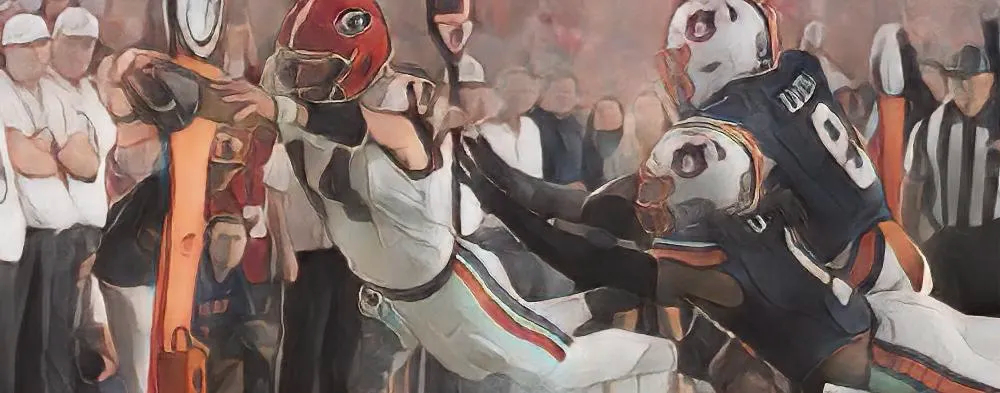
It would appear the Chambliss camp is losing in the court of public opinion and the sports media at this point. Tom Mars now says Chambliss isn’t trying to challenge the NCAA’s rules. He just wants his medical redshirt that Ferris State didn’t apply for. It seems this esteemed member of the bar doesn’t understand the concept of precedent.
Of course, all of this probably won’t matter in a state court in Oxford, Mississippi. The judge will be facing reelection and knows a politician’s first job is to get reelected.
Say it ani’t so the elected judge in charge is based in Oxford Mississippi.
Somewhere Corch Urban Meyers is smiling reading this story. 😂
Irvin, IRVIN Meyers. Get it right friend.
Mize
This sport is going beyond stupid.
The management of Division One NCAA isn’t going beyond stupid. It went beyond stupid generations ago.
It kept ignoring Antitrust laws prohibiting restraining the organization from restricting factors of production, i.e., the players in the market. The FBS universities wanted the Supreme Court to affirm that the Sherman Antitrust Act applied to college sports when Georgia and Oklahoma filed suit in 1981 in order to suck up big television dollars. The FBS universities loved the Sherman Act when in 1984 the US Supreme Court agreed.
Once the Division One universities got the revenue pipeline going just one way and the players started saying, “hey, how about us?” the NCAA and Division One universities answered, “Sherman Antitrust Act? Restraint of trade? Never heard of it.”
The players have zero policy and rule making authority so they could not effectively assert their rights at the NCAA convention level.
Their only remedy is the courts. In the period of 1984 through, say 2010, the conference revenues, while large, were not enough for players to have an expectation of seven figure distributions and with the 5 to play 4 limits it wouldn’t be worth the time and cost to sue.
These days the players see recycled mediocre coaches getting multi million dollar contracts and they know that the increase in the pool to pay coaches and administrators comes from the revenue pool available for them to tap. It is worth filing suit now.
The lesson is that the NCAA, the conferences and universities could years ago set a reasonable framework for the players sharing revenues and they consistently refused.
Those who run D-1 sports have been incredibly stupid.
I can’t argue with any of that. Pretty well said.
I never saw Tom Mars come to the defense of AJ Green or Todd Gurley and made a lot of baseless claim about UGA as an institution during the Fields and Mays episodes. Needless to say, I’m not a fan.
You never saw Mars come to the defense of Green and Gurley because Green and Gurley did not hire him to defend them.
That raises another indictment of the UGAAA and Greg McGarity. Green trusted that his Atletic Association would look out for him and he naively did what the AD told him to do. In the Gurley case McGarity made a big deal of, and patted himself on the back for, hooking Gurley up with a lawyer. It wasn’t because McGairty was motivated by Christian charity towards his star player’s Mother’s financial emergency. By arranging a lawyer for Gurley the AD could make sure that Gurley wasn’t going hire a lawyer who would sue the NCAA.
My 9:11 am post was not a praise or condemnation of Mars. Nor did
I intend to express an opinion one way or another as to the merits of Chambliss’s suit. I can see arguments on both sides. My point is that the NCAA and it conferences got themselves in this situation by refusing to recognize that the players are factors of production of NCAA competitions and formulating reasonable rules to regulate eligibility and access to financial benefit.
“…the NCAA…got themselves in this situation by refusing to recognize that the players are factors of production …and formulating reasonable rules to regulate eligibility and access to financial benefit.”
The Senator was clear on this point well before most of us – even those with legal backgrounds – even thought to think about it.
I do wonder why Chambliss wants an extra year in college. Is he getting bad reports about his NFL prospects? How much of his NIL money is he paying Mars? Is Ol’ Kiss kicking some $$ in because Golding wants to win it all when Kiffy couldn’t?
I’m specifically talking about Mars and the slaps he has taken at UGA while practicing in Atlanta. FTMF.
I liked him a lot more back when he was playing keyboard for Frank Zappa.
https://en.wikipedia.org/wiki/Tommy_Mars
It was always for the children.
Remember: when they say it’s not about the money, it’s about the money. When they say it’s for the children, it’s about the money…
“The lesson is that the NCAA, the conferences and universities could years ago set a reasonable framework for the players sharing revenues and they consistently refused.”
Do you think the reasonable framework would have saved the amateur model, delayed what we are seeing unfolding today, or prevented what is happening today (with regard to revenue sharing — not with the mess that is the transfer portal)?
What that reasonable framework would be isn’t up to me. You know what the sellers of playing talent want. They want a framework in which they can have the freedom to sell their services for a price set by market forces and the freedom to have control over when they play. The buyers of playing talent want to have some foreseeability as to talent costs so they can budget and the ability to forsee from season to season who their talent will be. The consumers of college sports, that is, the ticket buyers and broadcast viewers say they want a product that is performed by legitimate college students competing for their school against students of other schools.
The solution is a structure that best meets all those objectives.
There is a solution out there. The stakeholders can either work a solution or bitch until the cows come home.
Even now, when doing so might stop the bleeding, the NCAA apparently still refuses to condone making players employees. As long as it’s the front man for the schools, the current situation isn’t going to get any less anarchic.
I don’t know if the SEC and Big Integer are looking to create a new governing body (my guess is not but I stand to be corrected) but if they are or do, I wonder if they’re going to bite the bullet, classify players as employees and enter into collective bargaining.
The only rule that needs to change is the NCAA rule making the scholarship a 1 year renewable commitment. If they allowed colleges to enter into a 2-4 year agreement with an athlete, this whole transfer thing could be resolved. You want to release a player … you pay. You want to leave a program before the term of the contract … you pay. If a college and an athlete want to enter into a 1 year renewable agreement, fine.
Companies enter into long-term contracts with contractors every day. This doesn’t need to hard, and it doesn’t need the overhead of a players’ association and NLRB oversight.
I remember a story I was told as a young man in Germany. During the Middle Ages most European towns had only a single lawyer. They were not wealthy. Once a town grew to include two lawyers the lawyers wealth and numbers began to rapidly multiply.
If they can negotiate the length of the contract then market forces will have star players doing 1 year deals anyway and/or buyouts will happen so no net change. Also, labor laws have trip wires that if you have all 1099 workers and everything is standardized about their work and compensation then under ERISA a judge is likely to rule they are employees. Add contract holdouts to the mix and the whole thing stays on the same track of falling apart.
The NCAA didn’t have to think about it because, until recently, college athletics was viewed as entertainment, not a business. That is the basis of the baseball antitrust exemption. It is only in the past few (relatively) years that college athletics has been perceived as mostly a business, rather than primarily entertainment, and that’s when the legal foibles began…
The universities viewed it as a business in 1981 when UGA and Ollahoma sued the NCAA claiming the NCAA restrained trade. That was 45 years ago.
We could see this coming from a mile away. Rules ain’t no rules if there is no enforcement! Twist them anyway you desire. My Uncle Jake used to say” If it don’t fit, force it”. Get me outa here Percy!!!
Reply to DDB’s post at 11:30 a.m.
You put your finger on it. Ole Miss is guaranteed will pay him more in 2026 than an NFL team will guarantee a 4th round or lower pick.
I think so as well. His toolbox is geared to the College game and not to the NFL. I told people during the Sugar Bowl that Chambliss’ play was like that of Manziel or Chad Kelly against Alabama. Thus he has more value for a college year than he will probably ever see in the NFL.
Reply to eethomaswfnc at 11:31 am
I get it. Not trying to suggest you should think highly of him. I was pissed at the Fields claim as well. The Mays stuff didn’t bother me. If Cade Mays no longer wanted to be on the Georgia team we were better of without him.
Huh. So, a Bobo just won a Super Bowl. 😂
-Northstar Dawg
BigX and SEC have finally figured out the horrible box they are in. Using the NCAA is dead for fixing the problem thanks to the horrible legal beatings they’ve taken over amateurism. Both conferences are now coming around to the fact the need to set their own rules but they can’t be in collusion together on the rules since being in competition with each other is the only Get out of Jail Free card they have left. But neither want different rules or the inter conference games fall apart and with that so does the Disney deal. We’d be back to the NFL / AFL days. I truly believe they know they’ve killed CFB and CBB and will have to let chaos reign until some legal challenge makes its way to SCOTUS who I’d bet will punt to Congress to fix under some interstate/employment/Fed vs State vs Private arguments.
My ultimate guess is they find a way to sell University branding rights to billionaire team owners who form new professional leagues that meet all the criteria legally for pay, transfers, eligibility, etc. Tying academic requirements to such leagues will be the kicker and probable can’t be done. You can be drafted and play for UGA, Inc but being a student will be optional and probably something you don’t have time for. They’ll wear red & black with silver britches, play at Sanford-Smart stadium but they won’t be students and will change among teams freely. It’s football, it’s entertainment, it’s my brand so yeah, I’ll watch. But the passion will be gone.
If this is the outcome, my golf game will get a lot of work on fall Saturdays.
Then I hope your improving handicap is able to salve the pain of not cheering for your class AAA “University of Georgia” Bulldogs.
I have a feeling there will be a lot of people doing similar things.