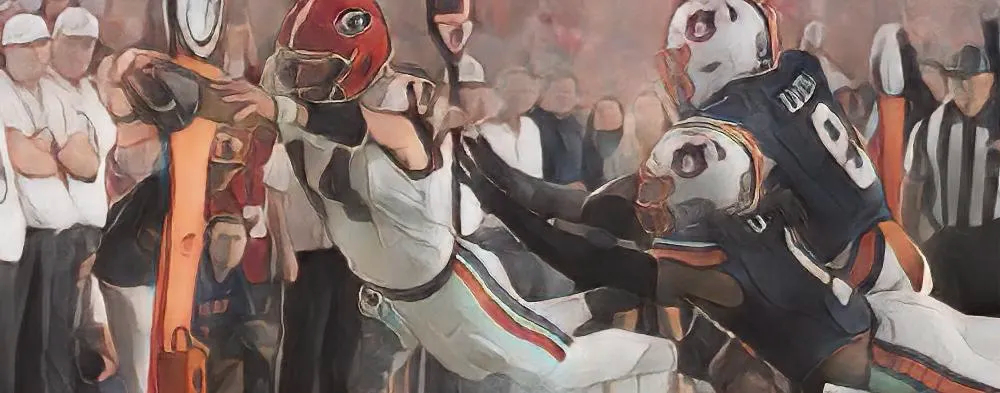
Of all the rules out there, I can’t think of one more controversial in recent years than the targeting rule. Not just because it seems somewhat objective when applied, but because most seem to believe it is a detriment to the sport, making football “softer”. Talk about surprised when I watched college basketball this year and see countless games extended by minutes to determine if they need to apply a “flagrant 1” or “flagrant 2” when reviewing guys scrapping in the paint. If there’s one that’s worse, it’s the flagrant reviews in college basketball, if you’ve been watching. Seriously, it was not necessary. At all.
Anyway, apparently the Rules Committee is giving the application of the rule a little look:
Targeting has, indeed, changed player behavior. In fact, since 2020 — what Shaw calls the height of targeting fouls — there has been an annual decrease in the number of targeting penalties. In 2020, officials flagged a player for targeting once in every four games. This year, that number is more like once in every seven to eight games.
Targeting, however, remains the most divisive, confusing and frustrating penalty among, not just college football fans, but coaches and administrators too.
The NCAA defines targeting as when a player initiates forcible contact against an opposing player to the head or neck area, most often — but not always — when leading with the crown (top) of the helmet against a defenseless player. If a player makes forcible contact with the head of a defenseless player, targeting may also be called.
Targeting carries with it a 15-yard penalty, plus the player who committed the act is disqualified for the remainder of the current game. If the penalty occurs in the second half of a game, that player is also disqualified for the first half of the next game.
When exploring the penalty structure this offseason, officials must determine if the disqualification — and the carryover disqualification — is still warranted. Could rules officials create two different levels of targeting fouls, similar to flagrant fouls in basketball?
Okay, I highlighted the statement in the quote on purpose, because somehow it feels like we’re getting targeting calls more frequently than the stat above, and less frequently when it needs to be applied to our benefit. Case in point:
I digress, and I have stats to back that up, but, seriously, it seems to be a liberally applied rule.
My suggestion: keep it, but make the player sit out a half at worst. If it’s really serious, then it should apply to ensure player safety and encourage coaches and players to teach proper tackling. Otherwise, if you want people to really avoid leading with the crown of their helmet, then play like rugby with no helmets and only head coverings. You might see it decrease by that alone.
Thoughts?
I know we are biased, but it does seem Georgia gets this called against it more often than the opponent does when playing us. I know Gunner should have been rewarded with some calls after hits he took after throwing passes.
I do think they need to have a level 1 and level 2 version of the penalty with only the more egregious resulting in ejection.
My concern with this approach is there will still be a lot of ambiguity when trying to determine level 1 vs 2 and lead to more controversy. Perhaps a better approach is the same player getting flagged for targeting twice in the same game. First time is 15 yards and a warning. Second time is 15 yards and a suspension for one game similar to how it’s currently done. Not perfect, but provides some leeway for calls in the gray area and penalizes habitual offenders.
It appears that the bigger the game the more likely you are to get targeting calls.
If you have two different conferences playing its seems to trigger more calls. Would love too see a per conference breakdown of how many targeting calls per play.
The officials are in a impossible position calling targeting. The collision happens too fast for the current criteria to be interpreted. Most big hits get a flag. The spirit of the rule is to stop the use of the helmet as a weapon thereby decreasing head/neck injuries. To logically enforce this I would make the following the criteria-
1) a defensive player must not lead with the crown of the helmet, contact with the face mask is permitted. The neck will flex if a player hits face first, crown first can cause paralysis.
2) a defensive player in the act of tackling must attempt to wrap his arms around the ball carrier. No shoulder only missile BS.
3) If an offensive player drops his head within 1 yard of a defender attempting to tackle the ball carrier there is no targeting. Think of the halo around the basket in basketball where there is no charging.
4) I have no idea how targeting is not enforced on offensive players. I’ve only seen it called once on a non turnover situation.
After targeting can we get rid of the blindside block penalty? As long as the blocker does not earhole the defender blindside blocking is part of the game. It used to be celebrated.
Your #3 is where my main rub is. The laws of physics should apply. My other gripe is it is easy to tell when a player is trying to injure another. That is the only time it should be called IMO. It’s football.
Correct – the rule is based on the ballcarrier being static, which is patently false.
On a related note I would also add #5: no targeting calls against runners inside the tackle box and +/- 5-10 yards up and downfield thereof.
I like this, but you aren’t saying that if any tackle is made without arms it’s targeting, right? You’d still need to make contact with the head of neck area, I assume.
No. My proposal is if the defender has time to “square up” and turn into a missle he has time to reach for the ball carrier with his arms. All tackling should include the arms whenever possible. That is what is not taught and enforced by coaches.
Really if the old spearing rule was applied we wouldn’t need targeting
I agree, but leaving the “if the defender has time” part up to officials is too much gray area as well.
Officials live in grey. They don’t call by the rules anymore on so many things.
When targeting is finally called on an offensive player, rest assured it will be a Georgia Bulldog getting called for it.
I’m fairly confident we were called for it on an *actual* offensive play (i.e, not trying to stop a return) at least once this season or last….
I’ve seen it once. The OT for Cincinnati in the 2021 sugar bowl got a flag for a late hit on our CB. He was ejected and we were able to get to the QB on his side the rest of the game.
That’s only to be used after the “ Excessive Success” is called on Georgia. Resulting in reversal of whatever good that you just thought happened for Georgia.
1 should read: “the neck will extend if a player hits face first”
Targeting was designed to get the Junior Rosegreen hits out of the game. Instead, it has gotten players making fundamentally sound football plays ejected and offenses (99% of the time) rewarded. That’s a feature not a bug.
You want to get dirty play out of the game? Now that players are being paid above the table, the conferences need to hit them in the wallets.
Officials have always had the option to eject players for dangerous play. Targeting 1 (15 yards only) and targeting 2 (+ ejection) seems to be the way to go. I still support the review. I just think the rule is too broad.
Targeting, IMO, should only be called like any other personal foul…15 yard penalty, 1st strike against the player (2 personal fouls against the same player in the same game is an ejection). I hate how it’s an automatic ejection and can keep a player out of the next game if called in the 2nd half of a game as most of the hits are not players trying to hurt someone, but rather a reaction that happens to fit the criteria that seems to change every year.
To BUCKEYE HQ, never forget bitch!
https://youtu.be/fqDpnS2Rz0A?si=IBnh32nAeHDBnJ3I
In da crib ….
And the BEARS still suck!
https://www.instagram.com/reel/DTYQRoBAQds/
The Targeting rule is a good addition as roughing is only typically used against the QB. The problem is they added “intent” to the rule and because that’s impossible to know they erroneously defined intent with the broad definition of “initiating contact with the helmet to the head/neck area of the opponent”. Initiating = Intent is the flaw. So the official and/or replay both see a hit and in fact DON’T determine intent…just if a hit occurred. They need to revise the rule back to the officials judgement just like PA, holding, etc. Yes, that will have fans screaming but that’s integral to the sport. A ref in real time or REQUESTED review by the head official (not initiated by the booth) can look and see if the play was merely head-to-head contact during a normal tackle (thus no penalty) or if the defender truly used his head/helmet as a speering move. Trained officials know the difference.
Tough to reform the penalty. They aren’t making equal money and fining is probably legally problematic. A kid caught targeting on the opening KO of the 2nd half, however, is punished more than the one who does it in the last minute of the game. Probably change it to 20 minute of continuous game time regardless when it occurs
I am over all the reviews…. It is killing basketball games (particularly the end) and VAR in soccer is taking much of the excitement out of it, hopefully if they get rid of the DQ we can do away with the targeting reviews all together….
If they are serious about reducing injuries they need to get rid of cleats and replace them with court type shoes. Force equals mass times acceleration. Reduce the force and you reduce the frequency and severity of the injuries. The change in footwear would uniformly reduce the speed (acceleration) of the game. This would be much cheaper and more effective than these ridiculous helmets and subjective rules that make football somewhat akin to ice dancing.
The biggest obstacle would be the shoe cartel but they could make a whole bunch of money, just replacing all all of the cleats with the new shoes. Unfortunately, the idea makes too much sense to ever be accepted by the football establishment.